
I am finally ready to deal with something that many of us find really hard to sort through.
Sentimental stuff.
Araarghhh!!
This is such a tough one for me.
Sentimental things seem to be so much more important than other possessions, and they are nightmarish to say goodbye to.
It’s like getting rid of little pieces of myself…
BUT – it’s important not to think like this. I must repeat the mantra:
I am not my things. I am not my things. I am not my things.
Phew.
If you’re struggling to declutter sentimental items, I understand completely. Unlike ordinary household clutter, these are things that remind us of people, places, experiences and versions of ourselves that no longer exist.
And getting rid of them can feel rather like getting rid of the memories themselves.
But it isn’t.
I discovered this when I finally tackled years and years of sentimental clutter that I had been hanging onto. It took far longer than I expected, and brought up all sorts of emotions, but it was one of the most worthwhile decluttering jobs I’ve ever done.
Here’s how I approached it, what I learned, and what might help you do the same.
Tip: If you’re tackling clutter throughout your home, rather than just the sentimental stuff, I’ve also written a complete guide to decluttering your home that covers where to start and how to make progress without getting completely overwhelmed.
Why Do We Keep So Many Sentimental Things?
Having lost three grandparents between me and my husband in the space of 18 months, we had our eyes opened somewhat to the needless hoarding of sentimental things.
I’m not talking about things we should keep, like war medals or old family photographs. I’m talking about calendars, souvenir pens, and all those random objects of no value (cups, pieces of furniture, cutlery, wedding favours, etc.).
When someone dies, someone else, somewhere has to sort through everything they own. Every possession, every piece of paper, every piece of furniture, is all handled by someone else who makes a decision about tossing it, donating it, selling it or keeping it.
Harsh, but true.
I was the executor of my late Grandmother’s will, and I spent hours sorting through her papers. In among them were photos of her and her husband, her children, wedding portraits, unlabelled pictures of friends, souvenir tickets, and a million little items of a life lived but imperfectly recorded.
What would someone find if they had to sort through your things tomorrow?
My husband and I talked about this a lot and it really made us both think about the irrelevant and unnecessary stuff we hang onto.
Are our children going to be interested in our school maths books? Will they read our college essays? Would I want either of my sons to read my tattered old diaries from the days before I was married? I blush to even think of it.
Of course, not everything we keep needs to be interesting or valuable to someone else. Some things are precious precisely because they mean something to us.
But it’s worth asking whether we’re keeping things because we genuinely treasure them, or simply because we have always kept them.
Sentimental attachment is just one of the reasons we find it so difficult to part with our possessions. I’ve written more about why we struggle to declutter and what we can actually do about it.
How I Started Decluttering My Sentimental Possessions
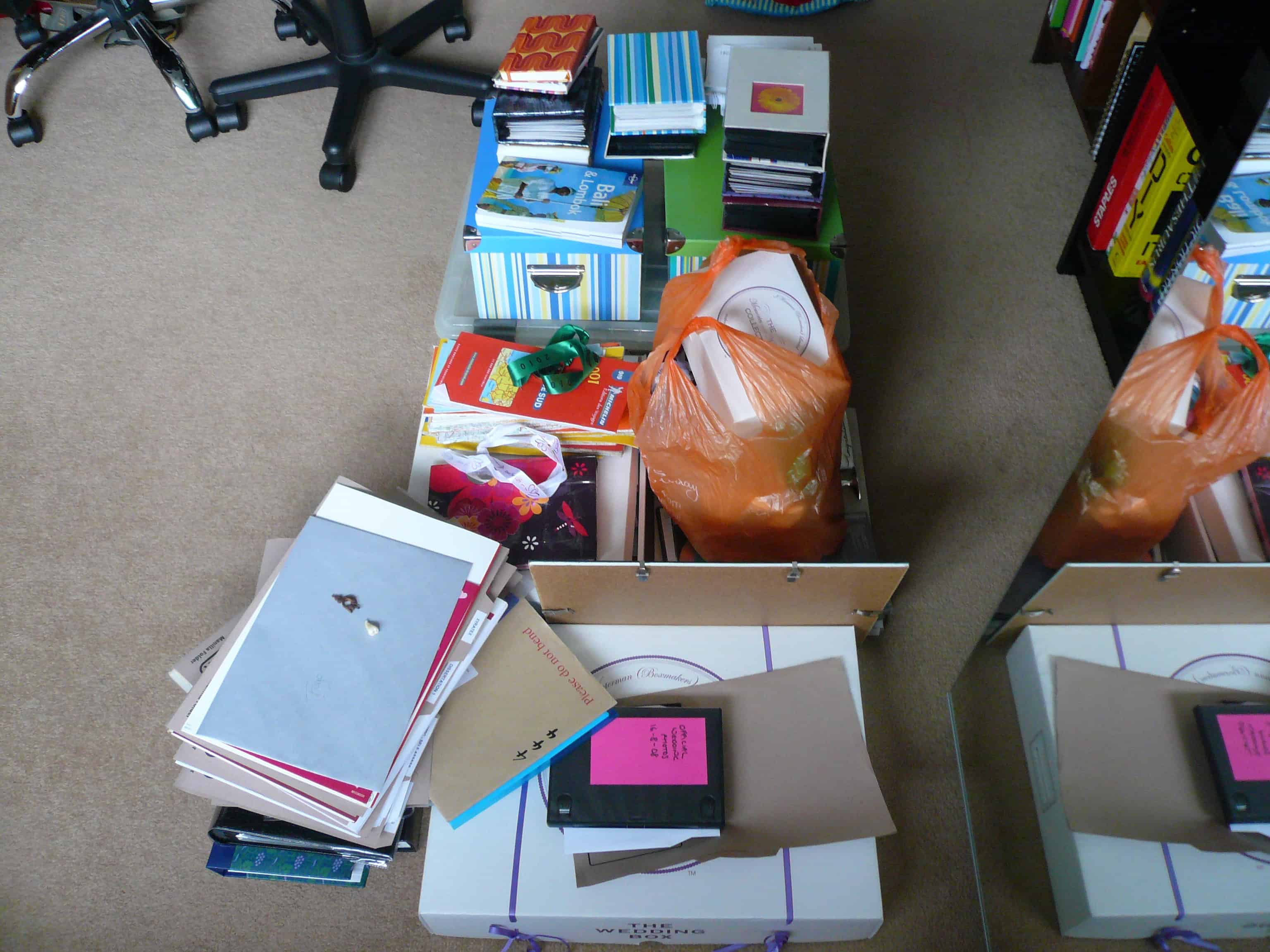
The very first thing I did was get absolutely everything together in one place. From my ongoing decluttering around the house, I’d already started keeping all sentimental stuff in one place (see my thoughts on keeping like with like to help you in your decluttering journey). Getting it all together helps you see the size of the problem, and it’s a reality check on whether you really need to devote that much space to items that are all about memories.
I had a huge collection – years and years of things I had saved – each item soaked in some emotion from a significant event, sometimes decades before. I knew this wasn’t going to be a quick job. I also knew that if I simply opened a box and started reminiscing, I’d probably get absolutely nowhere.
So I needed a plan.
1. I Set a Physical Limit on What To Keep
I found a nice box about the size of a large shoebox and decided that was my limit.
Having a physical boundary made an enormous difference. Instead of deciding whether every single item deserved to be kept, I had to think about which things were important enough to take up some of that limited space.
Depending on what you own and what matters to you, you might choose a larger keepsake box, a drawer, or a small collection of albums. The important thing is to give your sentimental possessions a defined space rather than allowing them to expand indefinitely.
2. I Photographed and Scanned Things I Wanted To Remember
I decided to scan or photograph everything that I wanted to keep a record of. This was particularly useful for old paperwork, tickets, cards, certificates and other flat items. Some things are lovely to look back on occasionally, but there’s really no reason to keep the physical object and a photograph can preserve the memory without taking up space in your home.
Of course, there are things for which a photograph simply isn’t a substitute. A handwritten letter from someone you love, for example, might need to be kept in its original form (e.g. I kept the letters my nan wrote me when I was at university).
Always make sure your digital copies are backed up properly before you get rid of the originals – having a solid backup strategy is more important that it has ever been for the ever-increasing amounts of digital data we all store.
3. I Kept The Things That Really Mattered
My plan was to only keep physical items of the most precious nature. Things like my old school reports, an old passport with all my travel stamps, and a plane ticket from a trip around the world.
Bearing in mind the limited space, I found it easier to really prioritise the items that I knew I wanted from those that I had kept out of habit (like every birthday card from milestone birthdays).
4. I Thought About The Person Who Might Eventually Sort Through My Possessions
One of my original rules was that the contents of the box would not be too boring or embarrassing for anyone else to sort through when I am gone. Which, given some of the contents of my old diaries, was quite an important consideration! But joking aside, I found this a helpful way to look at things.
Would someone else understand why I’d kept this?
Would it tell them something interesting about my life?
Would it be something I’d want my children to find?
Imagining someone else having to sort through your things is a really useful way of gaining perspective.
5. I Gave Myself Time to Make Decisions (a Lot of Time!)
The sorting process actually took around three passes over three years.
Yes, three years.
So if you’re struggling to get through your sentimental clutter in a single afternoon, don’t worry too much about it. Some things are easy to let go of once you start looking at them properly. Others take a little longer. I found that things I couldn’t bear to part with on the first pass were much easier to release when I came back to them later.
Perhaps the emotional attachment had faded, but more likely I think it was a process of letting go. Time to accept that I didn’t need to keep so many things after all.
You can always put the difficult things to one side and return to them later.
The important thing is not to let a handful of difficult decisions stop you making progress with everything else.
6. I Was Prepared For The Emotions
Wading through all the things I had saved made me feel so grateful to be where I am now.
But this was not an entirely happy process.
It took hours and hours, and I went through such a range of emotions – grief, anger, wonder, surprise, sadness, happiness, pride and finally… RELIEF and FREEDOM! That’s quite a lot to go through while sitting on the floor surrounded by old paperwork.
Sentimental clutter can bring back memories that you haven’t thought about for years. Some will be wonderful. Others might remind you of difficult relationships, unhappy periods or people you’ve lost.
And sometimes you’ll find yourself wondering why on earth you kept something in the first place.
If it all feels too much, just stop and take a break from the past. It doesn’t all have to be dealt with in one sitting.
Does Keeping Sentimental Clutter Keep us Stuck in the Past?
One of the things that surprised me most after it was done was how much I had felt mired in the past because I had all that stuff hanging around in the house.
Making the choice to let it go made me feel lighter.
Lighter, freer, and healthier.
I think if you spend too much time thinking about, organising and collecting the past, you cut off your enjoyment of the present and take away time that you could be using to plan the future.
I am terribly guilty of this, but sorting it all out and releasing it all helped me realise that it’s not good for you.
And I don’t think this is just about the physical space that sentimental possessions occupy.
It’s also the time we spend storing, moving, organising and looking after things that don’t necessarily add anything to our lives today.
Every box is something else to store. Every collection is something else to manage.
And all those possessions require our attention, even if it’s only when we move house, rearrange the cupboards or find ourselves looking for something else.
I had spent years preserving objects from my past, but I was beginning to wonder what I was actually gaining from keeping them.
Why Was I so Attached to my Sentimental Possessions?
I really did have a terrible problem with hoarding mementos.
Why, I wonder?
Did it stem from the psychological insecurity of growing up in an emotionally deserted home?
Was it an attempt to validate my life and my experiences because my parents didn’t ever really provide that for me?
Was it just that I have an archivist-type personality and love to keep and categorise things?
I really don’t know.
Exploring why you keep things can help self-awareness of behaviours and prevent clutter reaccumulating in future. For me, I realised that I didn’t need every ticket, certificate, card or diary I’ve ever owned to prove that I’ve lived my life.
My life has been lived even without any of it.
The Result: One Small Keepsake Box
It’s done!!!
And here it is now:
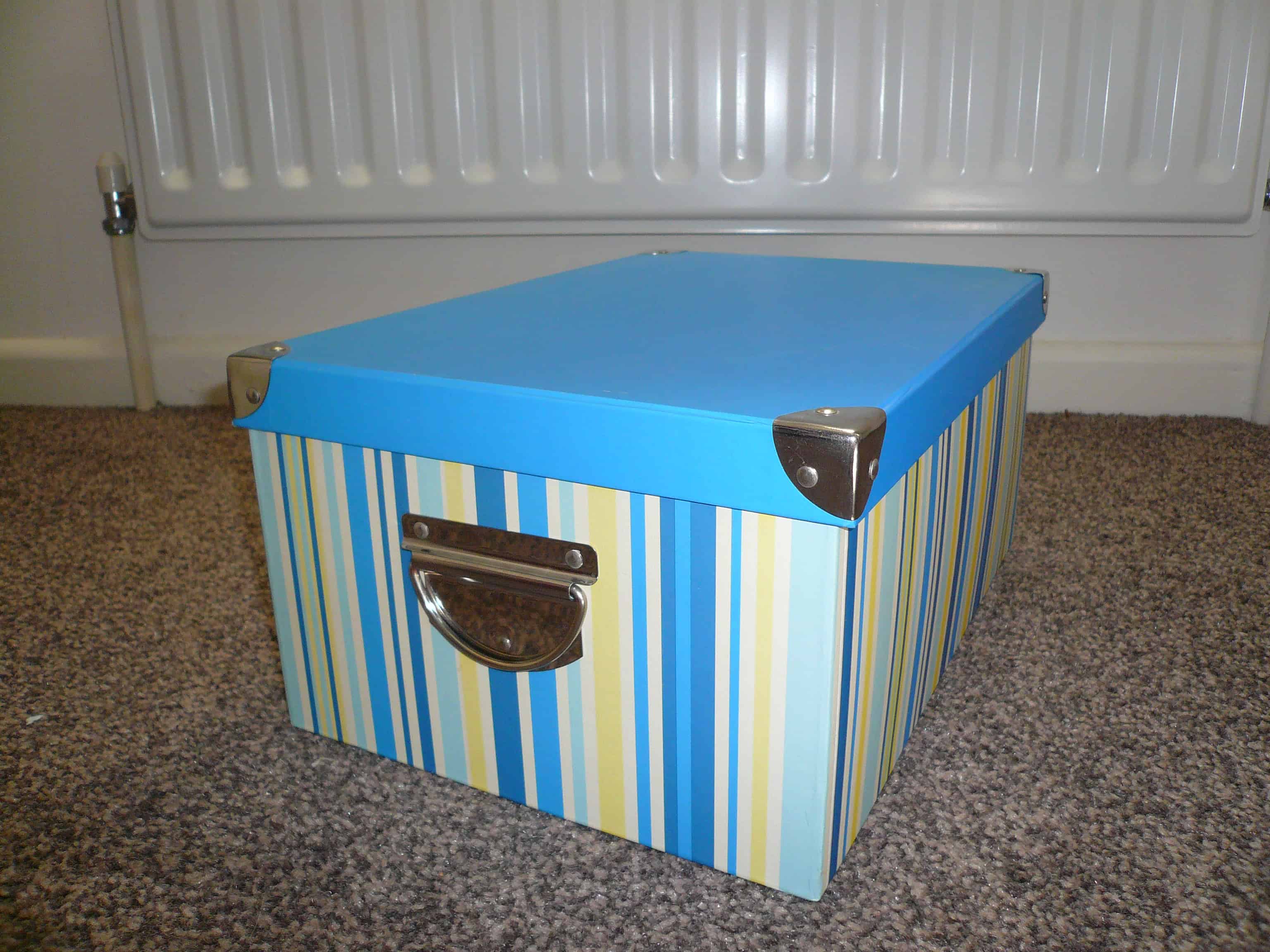
I am SO PLEASED that I don’t have all that stuff hanging around any more, not least because of the sheer amount of space it was taking up.
And that box isn’t quite full yet!
I feel so, SO much better for finally completing this job.
I feel like I’ve got my life in order – like I’ve somehow got my past in order, if that makes sense.
The things I’ve kept are the things that actually mean something to me. And because there’s so much less of it, I can enjoy what remains without having to wade through years of things that really don’t matter anymore.
How To Start Decluttering Your Own Sentimental Items
If you’ve got boxes of sentimental possessions that you haven’t been able to face sorting through, here are the things I’d suggest based on my experience.
- Choose a space for what you want to keep. A keepsake box, drawer or small collection of albums gives you a physical boundary to work towards.
- Start with the easier things. Old tickets, leaflets, certificates and other paperwork may be less emotionally difficult than photographs and personal letters.
- Ask why you’re keeping each item. Is it something you genuinely treasure, or something you’ve simply never made a decision about?
- Photograph things you want to remember but don’t need to own. Keep the memory, rather than automatically keeping the object.
- Be selective about duplicates and collections. You probably don’t need every birthday card, every piece of children’s artwork or every souvenir from a particular holiday.
- Put the hardest decisions aside. You can come back to them in a few months, or even a few years. There’s no deadline.
- Don’t feel you have to get rid of everything. This isn’t a competition to see how little you can own. The purpose is to keep what matters and let the rest go.
Above all, remember that sentimental decluttering isn’t about erasing your past.
It’s about deciding how much of it you want to carry around with you.
I started with years and years of things I had collected, each item soaked in some emotion from a significant event, sometimes decades before.
I finished with one small box.
And I haven’t lost those years, those experiences or those memories, I’ve just stopped storing quite so much evidence of them.
If you’re finding it difficult to let go of things because of the memories, emotions or guilt attached to them, my short course, The Stuff You Can’t Let Go Of, helps you work through those decisions at your own pace.
It’s a practical and gentle approach to dealing with the things that are the hardest to part with.
