
If you want to declutter your desk, the first thing to understand is that clearing the surface and actually dealing with the clutter are not the same thing. You can move everything into drawers, stack your paperwork neatly, buy some lovely new storage boxes and still find yourself right back where you started a few weeks later, because the things that caused the clutter haven’t gone away.
I know this because a while back I spent months trying to clear my own desk, and the process taught me something important about the relationship between clutter, unfinished jobs and the decisions we keep putting off.
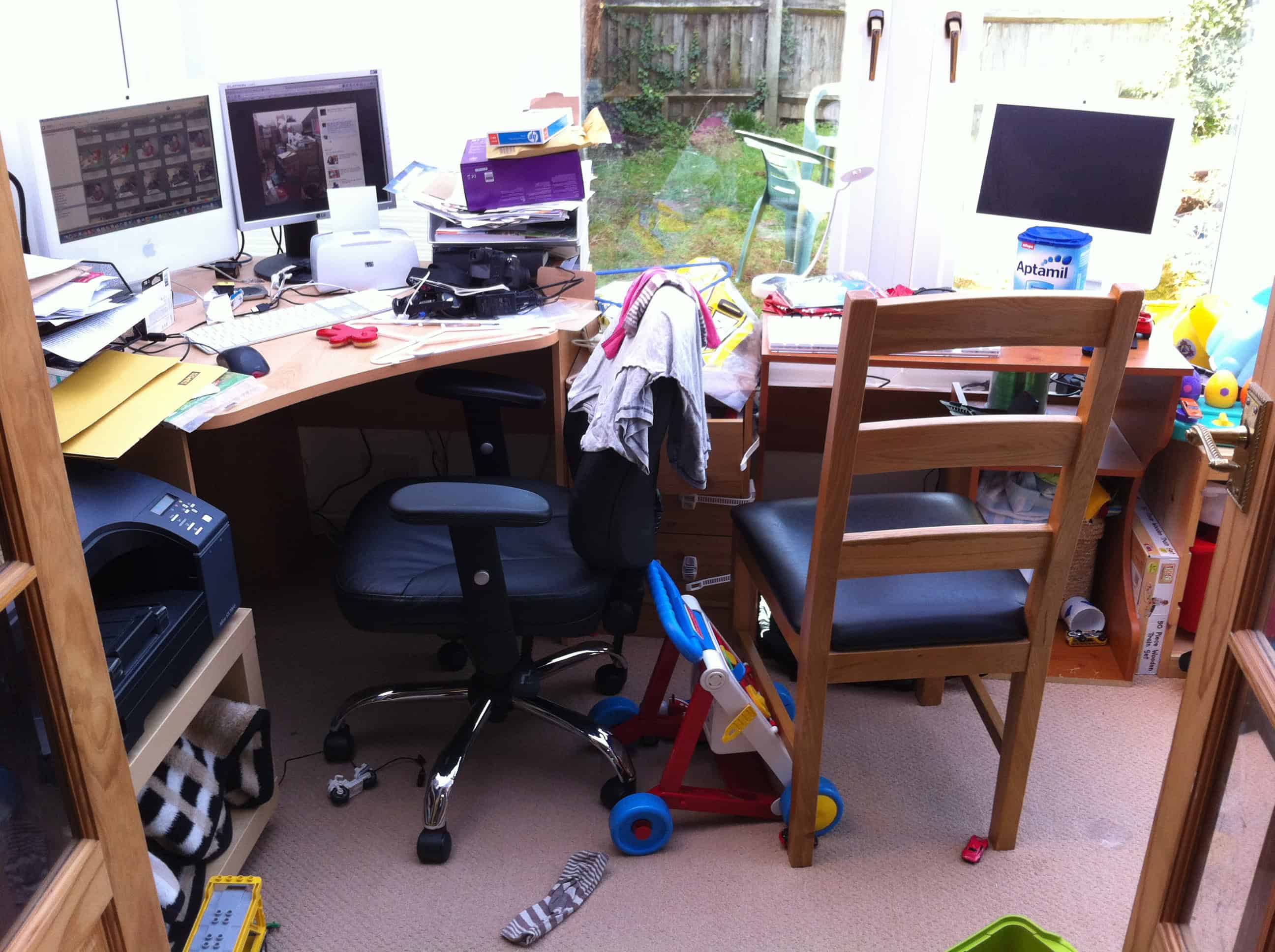
This was my desk:
Why does your desk get so cluttered?
My desk has always been the place where I process almost everything that comes into my life. It’s where I research everything from school information and health to films and books, deal with household administration and finances, sort paperwork, write letters and cards, sell things on eBay, organise photographs, edit videos, write code and, of course, blog.
With so many different activities competing for the same space, you might think that is the reason why clutter accumulates, but I realised it wasn’t that at all. The real problem was the number of things I started and left unfinished.
A letter that needed a reply, photographs that needed scanning, something I intended to sell, paperwork I wasn’t quite sure what to do with and the inevitable collection of miscellaneous objects that didn’t seem to belong anywhere else would gradually accumulate until there was very little space left to actually work.
And every time I wanted to do something, I had to negotiate my way around (and deal with all the emotions around) everything I hadn’t finished doing previously.
The difference between tidying and decluttering your desk
There’s nothing difficult about making a desk look tidy, provided you have somewhere to put everything that’s on it. You can collect up the paperwork, straighten the piles and move the miscellaneous objects into a drawer, and within half an hour you’ll have a tidy-looking workspace.
The trouble is that you haven’t reduced the amount of clutter you own, and you haven’t dealt with the jobs that the clutter represents.
That pile of paperwork still needs sorting, the photographs still need organising, and the things you intended to sell are still waiting for you to photograph them, write descriptions and arrange postage.
You’ve simply moved the problem somewhere else.
When I started properly decluttering my desk, I wanted to reach the point where everything had either been dealt with, put away somewhere sensible because I genuinely needed to keep it, or removed from my home altogether.
This distinction actually applies to more than just possessions, and it’s something I’ve written about in Decluttering Time Not Space, because the things we accumulate often represent commitments on our time as well as demands on our physical space.
How I finally cleared my cluttered desk
There wasn’t one spectacular weekend when I suddenly transformed my workspace, because the whole process happened gradually over many months as I worked my way through the accumulated piles.
Some things were straightforward enough to deal quickly, while others required considerably more thought, time or emotional energy.
During that particular year, two big projects made the process much slower than I would have liked.
- A major sort through of my sentimental possessions (some of which were scanned or even sold on eBay, and a lot of which had been living on my desk for months)
- The massive collection of paperwork and photographs from my late grandmother, who passed away earlier that year (I was the executor of her will, which meant that alongside the emotions of sorting through her possessions, there were also practical and administrative responsibilities that needed my attention).
Neither of those things was a task I could finish in an afternoon, and quite a lot of the associated paperwork and possessions spent months living on my desk while I worked through them.
I could have put everything into boxes and hidden it away, but I knew that doing so would simply postpone the decisions and leave me with the same problem to deal with later.
Instead, I gradually worked through everything until there was less and less left, and one day I realised that I could actually see the surface of the desk again. That was encouraging enough to keep me going, and eventually I reached the point where there were only a couple of outstanding jobs left in my in-tray.
When I dealt with those final pieces of paperwork, I had genuinely reached the bottom of the pile.
There was nothing waiting to be filed, nothing hidden in a drawer for later and nothing sitting there reminding me of another job I really ought to get around to doing.
It was FINISHED!
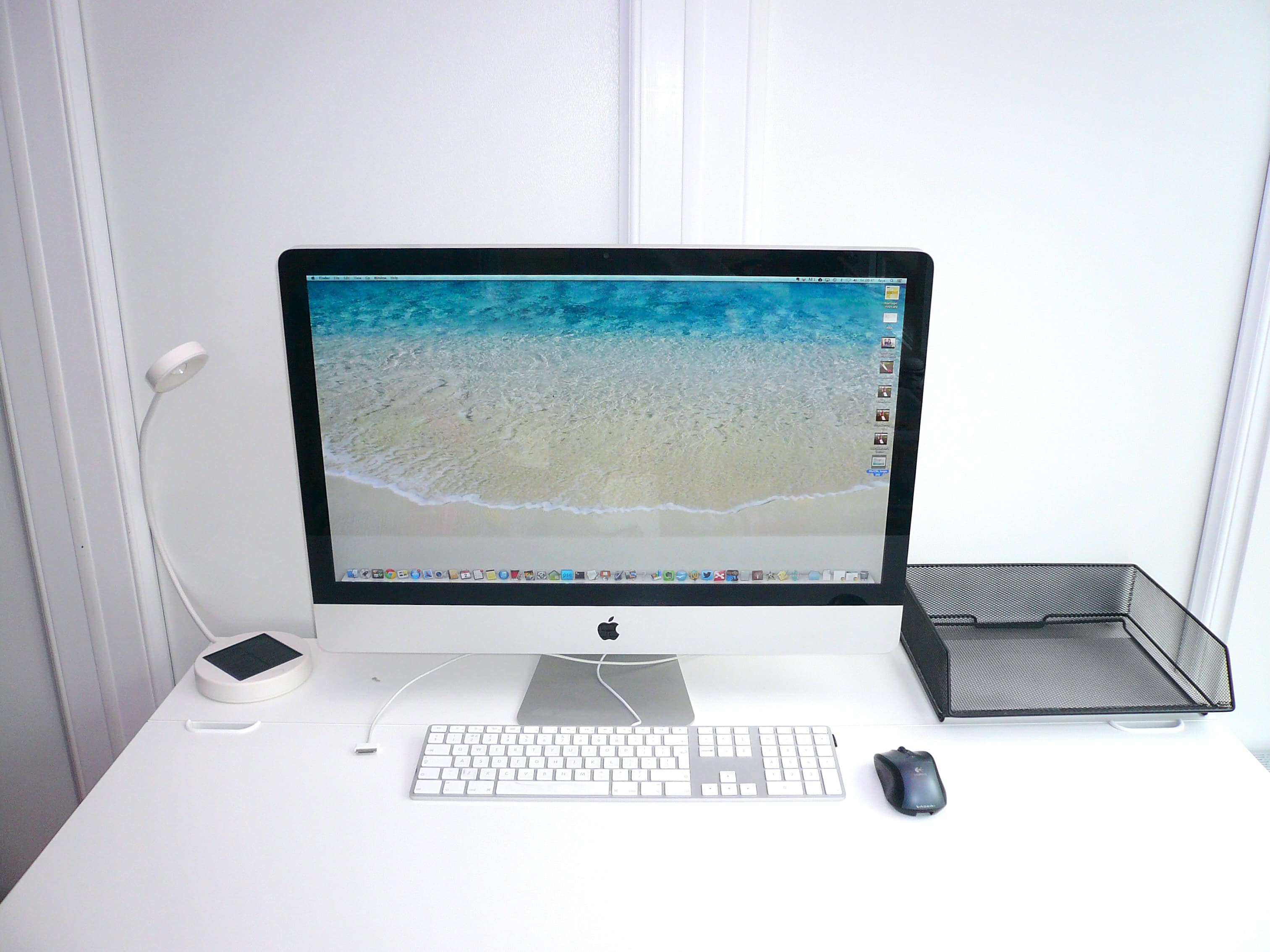
(It took me so long I had actually bought a new big desk and new Mac by the time it was done to replace the two desks and three computers I had before – I promise this is the same conservatory lol)
I am so happy to have a nice clean, clear space to work in.
And once I’ve worked out what on earth I’m going to do to reduce all the children’s toys, I’ll be able to show you a photo that includes the floor 😉
Do you think I still need the in-tray?
I’d better keep it for now.
(Update: I no longer have the in-tray!)
How to declutter your own desk without creating more work
My own desk took months to clear completely, so I wouldn’t suggest emptying every drawer and cupboard onto the floor and attempting to deal with the whole lot in one go, particularly if you already have a busy life and limited time available.
Instead, start with a small section of your desk and work through the contents until you’ve finished that particular area, rather than becoming distracted by everything else that needs attention. The following steps are pretty much what I did:
1. Start with the things that are easy to deal with
Get rid of the obvious rubbish and anything that you immediately know you no longer need.
Old receipts, empty packaging, dried-up pens, outdated notes and the miscellaneous bits of paper that accumulate around a busy workspace can often be dealt with quite quickly, giving you some useful space without requiring any particularly difficult decisions.
2. Separate things that belong on your desk from unfinished jobs
Take a look at what remains and ask yourself whether each item is something you actually use at your desk, or whether it’s there because it represents something you haven’t gotten around to doing.
If something requires action, decide what that action is and when you’re going to do it.
3. Deal with paperwork rather than repeatedly rearranging it
Paperwork was one of the biggest contributors to my cluttered desk, partly because so much of it seemed important enough to keep but not sufficiently urgent to deal with immediately.
If you have accumulated piles of letters, forms, receipts and documents, try working through a small number at a time and make a final decision about each one.
Some paperwork will need to be retained and filed, some will require a response, some can be scanned or photographed (and you can get rid of the originals), and some can just be shredded or recycled.
The important thing is to avoid creating yet another pile of things that you’ll look at again later, unless there’s a genuine reason why you can’t deal with them now.
4. Give yourself more time for difficult possessions
Not everything on your desk will be straightforward paperwork or office equipment, and sometimes the things taking up the most space are connected with memories, relationships or periods of your life that you’re finding difficult to process.
My grandmother’s photographs and paperwork were a good example of this, because dealing with them involved far more than deciding which pieces of paper I needed to keep.
It’s okay to set these things aside while you work through the easier clutter. Don’t pressure yourself to deal with things before you are ready. However, I have found that leaving them in view helps to push you towards processing them much sooner than if you pack them up in a cupboard or chuck them in the loft.
I’ve written more about this subject in What To Do When You Get Stuck With Decluttering, because some possessions are genuinely difficult to let go of, and forcing yourself to make decisions before you’re ready causes stress and is more likely to derail your decluttering journey.
5. Finish each small job before starting another
One of the easiest ways to create more clutter is to start sorting something, become distracted by another area that needs attention and then end up with several unfinished projects.
If you have half an hour available, choose something that can reasonably be completed in that time, even if it’s only sorting one piece of paper or dealing with the contents of a single drawer. For each task, put away everything you’ve decided to keep, dispose of anything you’re getting rid of and make sure you’re not leaving yourself with a bigger mess than the one you started with.
You can always come back and do another section tomorrow, next weekend or whenever you have another opportunity, because small, completed jobs eventually add up to substantial progress.
How to keep your desk clear once you’ve decluttered it
Once you’ve finally cleared your desk, the next challenge is preventing it from becoming the dumping ground for everything that enters your home again.
I think the most useful habit is to recognise when something is being left on your desk because you don’t know what to do with it, or because you are procrastinating over getting it done.
If the item needs action, give that action a place in your plans; if it needs keeping, find it an appropriate home; and if you no longer need it, get it out of the house rather than allowing it to take up space indefinitely.
An in-tray can certainly be useful, particularly if you deal with a lot of paperwork, but it needs to be somewhere that incoming items wait briefly for attention rather than a permanent resting place for jobs you don’t particularly want to do.
The aim isn’t to maintain a completely empty desk every minute of the day, because a workspace is supposed to be somewhere you actually work, and that inevitably creates a certain amount of through-traffic.
What matters most is being able to clear it again without having to process six months of accumulated paperwork first.
You don’t have to declutter everything overnight
Looking back at the photographs of my desk, the thing that strikes me most isn’t how untidy it used to be, but how much time and effort went into changing it.
There was no dramatic transformation, no expensive organising system and certainly no magical moment when I suddenly became the sort of person who effortlessly keeps everything in its proper place.
I simply kept working through the things that needed doing, dealing with possessions and paperwork whenever I could, until eventually there was nothing left waiting for my attention.
And when I finally took that photograph of my clear desk, I was ridiculously pleased with myself.
That’s the thing about decluttering: you don’t have to transform your entire home to make a difference to how it feels to live and work in it. You just have to keep making progress, however slowly, and remember that every little job you finish is one less thing taking up your time, space and attention.
If you’re struggling to get started because there seems to be too much to deal with, my Too Much Stuff? Start Here course walks you through clearing one small space in 30 minutes, making the easier decisions first and finishing what you start, without turning decluttering into yet another enormous job.
You can’t clear out all your junk overnight – I know that for certain.
But small steps really do add up, even if it takes a few months before you can see your desk again 😌
